Charitable Documentation

Learn how to make the most of Charitable with clear, step-by-step instructions.

The Email Fields API

The Email Fields API was introduced in version 1.5 and provides a cleaner way to add new email tags or modify existing ones.

Defining a Field

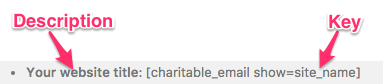
An email field is defined as an array with a few arguments, and a key which is used for the show parameter in the [charitable_email] shortcode.
Arguments

  • description: The description that will be shown for the email tag.
  • preview: The placeholder value that will be used for this email tag in email previews.
  • callback: A function that will be executed to get the tag value for a particular email.
  • value: A fixed value for the email tag. If this is set, callback will not be used and is not required.

In addition, an email field has a key which will be used when the tag is added.

Callback arguments

The callback function will receive three arguments:

  • $value: The default value (an empty string). This is provided primarily for backwards-compatibility purposes.
  • $args: The shortcode arguments. This will always include the show parameter but may include other arguments if these are applicable to the email tag.
  • $email: An instance of Charitable_Email. You can use this to get the objects associated with the email (usually one of Charitable_Campaign, Charitable_Donation or Charitable_User).

Adding a Campaign email field

Campaign email fields can be added using the charitable_email_campaign_fields filter:

function ed_charitable_email_campaign_field_callback( $value, $args, $email ) {
    $campaign = $email->get_campaign();

    return $campaign->get( 'some_field' );
}

function ed_charitable_add_email_campaign_field( $fields ) {
    $fields['some_field'] = array(
        'description' => 'A description of this field',                    
        'preview'     => 'Placeholder value',
        'callback'    => 'ed_charitable_email_campaign_field_callback',
    );

    return $fields;
}

add_filter( 'charitable_email_campaign_fields', 'ed_charitable_add_email_campaign_field' );

Adding a Donation email field

Donation email fields can be addd using the charitable_email_donation_fields filter:

function ed_charitable_email_donation_field_callback( $value, $args, $email ) {
    $donation = $email->get_donation();

    return $donation->get( 'some_field' );
}

function ed_charitable_add_email_donation_field( $fields ) {
    $fields['some_field'] = array(
        'description' => 'A description of this field',                    
        'preview'     => 'Placeholder value',
        'callback'    => 'ed_charitable_email_donation_field_callback',
    );

    return $fields;
}

add_filter( 'charitable_email_donation_fields', 'ed_charitable_add_email_donation_field' );

Adding a User email field

Defining a new user email field follows the exact same process, but with the charitable_email_user_fields filter:

function ed_charitable_email_user_field_callback( $value, $args, $email ) {
    $user = $email->get_user();

    return $user->get( 'some_field' );
}

function ed_charitable_add_email_user_field( $fields ) {
    $fields['some_field'] = array(
        'description' => 'A description of this field',                    
        'preview'     => 'Placeholder value',
        'callback'    => 'ed_charitable_email_user_field_callback',
    );

    return $fields;
}

add_filter( 'charitable_email_user_fields', 'ed_charitable_add_email_user_field' );

Modifying Existing Email Fields

Existing email fields can also be changed with these filters. For example, you can use this to change the callback for an existing tag, or to edit the description.

Changing a field’s callback

function ed_charitable_donor_address_email_field_callback( $value, $args, $email ) {
    // Return the donor's address.
}

function ed_charitable_set_donor_address_email_field_callback( $fields ) {
    $fields['donor_address']['callback'] = 'ed_charitable_donor_address_email_field_callback';
    return $fields;
}

add_filter( 'charitable_email_donation_fields', 'ed_charitable_set_donor_address_email_field_callback' );

Changing a field’s description

function ed_charitable_set_user_login_email_field_description( $fields ) {
    $fields['user_login']['description'] = 'My user login description';
    return $fields;
}

add_filter( 'charitable_email_donation_fields', 'ed_charitable_set_user_login_email_field_description' );
Still have questions? We’re here to help!

Last Modified:

What's New In Charitable

View The Latest Updates
🔔 Subscribe to get our latest updates
📧 Subscribe to Emails

Email Subscription

Join our Newsletter

We won’t spam you. We only send an email when we think it will genuinely help you. Unsubscribe at any time!

GiveWP Migrations New

White Glove Migration Service for GiveWP

Thinking about switching your fundraising platform from GiveWP to Charitable, but don’t want to risk losing your data or handle a complex technical setup yourself? Charitable’s White Glove Migration Service features:

👥 Flawless Donor Mapping: Safely transfer your entire supporter database with zero data loss.

📊 Complete Financial History: Meticulously preserve every historical transaction for continuous, accurate reporting.

🔄 Seamless Recurring Giving: Safely transfer active sustaining subscriptions without disrupting your incoming revenue or requiring your donors to update their information.

💳 Zero Gateway Disruptions: Keep using Stripe, PayPal, or any other GiveWP-compatible processor you already love.

🚀 Expert Technical Setup: Relax while our team handles the heavy lifting to install and configure your forms—plus, qualifying users get a full year of Charitable Pro completely free.

Visit this page to learn more.

automation Improvement

📢 New Feature Alert: Automation Connect 2.0 Is Here! 🚀

Thinking about connecting your fundraising data to tools like Mailchimp, Slack, or Google Sheets, but don’t want to hire a developer or write custom code? Charitalbe’s new automation addon has:

⚡ 17 Event Triggers: Instantly fire webhooks for a donor’s first gift, renewal payments, or reached campaign milestones.

🎯 Smart Conditional Logic: Use powerful AND/OR logic across 11 fields to only send data when it meets your exact criteria, like newsletter opt-ins.

📊 Custom Payload Control: Select from 80+ clean data fields across donor, donation, and campaign metadata so your apps get exactly what they need.

🚀 Pre-Built Platform Templates: Skip the setup from scratch with ready-to-go templates for Zapier, Make.com, n8n, HubSpot, and Slack.

🛡️ Reliable Developer Tools: Power your workflows with signed HMAC-SHA256 payloads, complete WordPress filters, and automatic retry logs.

automation Improvement

🔌 Charitable Meets Zapier: Connect to 7,000+ Apps and Automate Your Fundraising

Tired of manually copying donation data into accounting sheets or tracking down new donor signups? Put your administrative tasks on autopilot. Charitable is now officially on Zapier, giving you a powerful, no-code way to plug your fundraising directly into the rest of your favorite tools.

Every donation, donor signup, and campaign milestone can now trigger an automated workflow seamlessly.

What’s New:

♾️ Connect to 7,000+ Apps: Bridge your Charitable campaigns with everyday software like Google Sheets, QuickBooks, Slack, Mailchimp, HubSpot, Notion, Airtable, and thousands more.

⚡ 12 Powerful Triggers: Build deep workflows using smart automation triggers covering the entire donation lifecycle—including New Donation, New Donor, Subscription Cancelled, and Campaign Goal Reached.

📋 Pre-Built Action Templates: Get started in three minutes or less with our pre-made template combinations, like automatically logging new donations straight into a Google Sheet or firing custom donor welcome emails through Gmail.

🚫 Zero Code Needed: No complex webhooks or custom PHP scripts required. Just pick your trigger, choose your app, map your fields, and let Zapier handle the heavy lifting.

Ready to save hours of admin time? Grab Charitable Pro with the Automation Connect addon today and launch your first Zap!

Improvement Payments

🚀 Introducing PayPal Commerce: One Connection, Six Ways to Donate

Donors expect modern, flexible payment options when they support a cause. If they don’t see their preferred method on your donation form, they often disappear without a word. With PayPal Commerce, we are bringing a completely modernized checkout experience right to your campaigns.

Enjoy a single integration that upgrades your forms, makes giving seamless, and helps you capture every single donation.

What’s New:

🔌 One-Click Connection: Skip messy API keys and developer docs. Simply click “Connect with PayPal,” sign in to your business account, and your modern form is live in under five minutes.

💳 Six Ways to Give: Give your supporters instant access to PayPal balance, Venmo (US), Pay Later financing, major credit/debit cards, Apple Pay (Safari), and Google Pay (Chrome) all from the exact same form.

🔄 Flexible Recurring Giving: Fully supports monthly giving. Choose between the PayPal Subscriptions API (handled automatically on PayPal’s end) or Vault + Cron (handled securely right on your site).

💬 Friendly Error Recovery: No more confusing browser alerts. If a payment is declined, donors see plain-language, inline messages that guide them on how to fix the issue and complete their gift.

Ready for PayPal, modernized? Update to Charitable Pro 1.8.15+ (or Charitable Lite 1.8.11+) and connect your account today!

Campaigns New

⏳ Campaign Countdown: Drive Urgency and Lift Donations

Urgency is one of the most powerful tools in fundraising! Meet Campaign Countdown—a live, real-time timer built to turn procrastination into immediate generosity.

campaign_countdown_animation

What’s New:

⏱️ Live, Real-Time Urgency: Beautifully track days, hours, minutes, and seconds down to your campaign’s deadline w/ live-updating visual countdowns.

🎨 Tailored to Your Look: Choose between Boxed bordered tiles or a clean, single-line Inline display. Match your theme instantly with font and deep color controls.

🛠️ Place it Anywhere: Drop the countdown anywhere you like using the Campaign Builder field, a dedicated Gutenberg block, or a simple shortcode.

🚨 Smart Expiry Actions: Total control over the end state—choose to automatically replace the timer with a custom message, freeze it at zero, and more.